Madikwe: A Conservation Success Story in a Changing World
Fifteen years after an unforgettable photographic safari in South Africa, a photographer reflects on wildlife, memory and the challenges of protecting nature in a changing climate.
A Week I Will Never Forget
It was still dark when we climbed into the safari vehicle, wrapped in blankets and holding a hot cup of coffee. The mornings were cold, but I barely noticed. I was far too excited about what the next few hours might bring.
It was 2011, and I had come to Madikwe Game Reserve, in South Africa, to photograph wildlife. After years of admiring African animals in books and documentaries, I was finally there, camera in hand, surrounded by the sounds of the bush.
It was my first wildlife safari, and I could hardly believe it was happening.
After a brief introduction to our guide and a short safety briefing, the engine finally started, and we were on our way to discover South Africa’s wildlife.
It did not take long to encounter our first animal. My very first photograph was of a lion lying beside the track. Soon afterwards, we encountered another lion whose roar seemed to fill the landscape. I could hardly believe our luck.
The encounters kept coming. Zebras, hippos, African wild dogs, spotted hyenas and, of course, elephants. Animals I had dreamed of photographing were suddenly there, sometimes just a few metres away.
One of those encounters gave me a photograph I particularly enjoy revisiting: a spotted hyena resting on the reddish earth, its thick coat catching the warm sunlight while its face remained partly in shadow. The animal was lying quietly, yet there was something alert about its expression. I loved the contrast between the softness of the light and the powerful character of an animal so often misunderstood.
A zebra photographed in the warm afternoon light at Madikwe Game Reserve, South Africa, 2011.
My first photograph at Madikwe: a lion resting beside the track. It was an unforgettable beginning to the safari.
A spotted hyena resting on Madikwe's reddish earth, its coat catching the warm sunlight while its face remains partly in shadow. South Africa, 2011.
A lion with its mouth wide open in the warm light of Madikwe Game Reserve, South Africa, 2011.
Contact:
contact@josephBphotography.com
The elephants were equally fascinating. Their sheer size was astonishing, but what interested me most was the opportunity to observe them in their own environment. I was looking for the small details that make a photograph memorable: a gesture, an expression, the way an animal occupies the space around it.
For a wildlife photographer, it was everything I had hoped for.
Around eight in the morning, we would stop for a snack beside a waterhole, watching hippos surface nearby and learning more about them from our guide. On another drive, we came across a lion beside a freshly killed animal. It was a powerful reminder that the natural world we admired was also governed by predation and survival.
Two elephants moving through the tall grass and bushveld of Madikwe Game Reserve, South Africa, 2011.
A group of hippos resting in the water at Madikwe Game Reserve, recalling our early-morning stops beside the waterhole in 2011.
A lion resting beside its prey in the warm afternoon light at Madikwe Game Reserve, South Africa, 2011.
How seawater becomes salt
What fascinated me most in my conversations with the sauniers was how little the process depends on machinery and how much it depends on understanding natural forces.
The raw material is simply seawater. The real tools are sun, wind, gravity, clay — and experience.
The principle sounds simple: bring seawater into the marsh and allow evaporation to increase its salinity until salt crystallises. In reality, it is a carefully managed journey. Water is guided through a succession of increasingly shallow ponds and channels. As it travels, sun and wind remove water through evaporation and the brine becomes progressively more concentrated.
The saunier controls that circulation, reading the weather, water levels and salinity, making small adjustments that determine what will happen later in the crystallisation ponds. Eventually the concentrated brine reaches the aires saunantes, the shallow harvesting beds. There, coarse salt crystallises on the clay bottom and is gathered by hand. Under suitable warm, dry and lightly windy conditions, delicate crystals of fleur de sel form at the surface and are carefully skimmed before they sink.
Nothing about the process is automatic. Rain dilutes the brine. Wind changes evaporation. Water must be moved at the right moment and in the right quantity. Outside the productive season, channels, banks and basins have to be maintained so that the entire system can function again.
Standing there, the expression “cultivating salt” suddenly made sense. The saunier does not manufacture salt in the industrial meaning of the word. He or she creates the conditions in which a natural process can succeed.
The seasonal dimension of the work also struck me. The summer harvest is only the visible part of a much longer cycle. The marsh must be prepared, repaired and watched; channels have to remain functional, banks maintained, and the circulation of water understood long before the crystals appear. A successful harvest is therefore the result of accumulated observation rather than a single gesture. The salt we see at the end is almost a record of everything that happened before it: the heat, the wind, the absence or arrival of rain, and the decisions of the person managing the marsh.
The people behind the landscape
That was why the conversations mattered as much as the photographs. The sauniers I met did not speak about salt as an anonymous commodity. They spoke about weather, water, technique, seasons and the marsh itself. There was precision in the way they described their work, but also attachment.
Watching a long wooden tool move across a shallow basin beneath a huge sky, I became aware of the balance between physical effort and observation. Their gestures may be repeated, but their work is never entirely repetitive because the conditions are never exactly the same.
As a photographer, I recognised something in that relationship. You prepare. You learn your tools. You develop technique. But ultimately, you cannot command the conditions. A saunier cannot order the wind to blow. I cannot order the light to arrive. You can only become better at recognising what the conditions are offering you.
That parallel stayed with me after I left the marsh. In both practices, technical competence is necessary but insufficient. The tool matters, but judgement matters more. Knowing when not to intervene can be as important as knowing what to do. A saunier reads subtle changes in water and weather; a photographer reads the direction of light, the movement of an animal, the way a background is changing. Neither can guarantee the result. Both can only prepare themselves to recognise the moment when the conditions become right.
A woman harvesting sea salt in the traditional salt marshes of Île de Ré
A salt worker tending the salt pans of Île de Ré using traditional methods.
A ruddy turnstone at the edge of the salt marsh.
Salt, landscape and wildlife are the same story
The importance of the salt marshes extends far beyond the salt itself. The same human-shaped network of water, mud, shallow pools and exposed banks also creates habitat for wildlife, including birds feeding or resting along the Atlantic migratory routes.
That connection became one of the revelations of this trip. I had arrived thinking primarily about landscape photography, but the marshes constantly redirected my attention towards wildlife.
Northern Lapwings, waders, cormorants and a Marsh Harrier became part of the visual language of the place. The salt landscape and the wildlife landscape were not separate subjects. They occupied the same water, the same evening light and the same frame.
A flock held together by water and reflection — wildlife as part of the marsh rather than apart from it.
I became less interested in making a catalogue of species and more interested in the moments when an animal became completely integrated into a composition: a long reflection beneath a bird standing in golden water; concentric circles spreading from a bill; a droplet suspended for a fraction of a second; wings cutting across a landscape; the green iridescence of a lapwing appearing only when its angle to the sun was right.
The animal remains essential. But it is no longer isolated from its surroundings. It becomes a shape within light, water and space.
This was particularly true with the cormorants. They can be visually awkward birds: dark, angular and often photographed simply as silhouettes or documentary subjects. But in the marshes I became interested in the way their bodies interrupted the horizontal calm of the water, or how their posture echoed the lines around them. The same was true of the lapwings. Their colour is not immediately obvious; it appears and disappears with the light. Waiting for that brief iridescence made the photograph less about identification and more about revelation — about showing something that was present all along but visible only under particular conditions.
Great cormorants in the salt marshes of Île de Ré — three moments of light, movement and quiet observation.
When the marshes become abstraction
There were also moments when the subject almost disappeared. Seen from the right position, the salt marshes ceased to read as ponds and channels and became arrangements of colour and geometry. Water reflected the sky. Vegetation formed bands of red, ochre and purple. Narrow strips of earth divided the surface into irregular shapes.
The landscape moved towards abstraction. I was still photographing a real place — nothing had been invented — yet scale and perspective made the image less about describing Île de Ré and more about colour, texture, rhythm and matter.
This is one of the directions that increasingly interests me in my Fine Art work: allowing nature to remain recognisable while revealing the structures hidden within it.
The camera can do something interesting here: it can describe a place faithfully while also freeing it from the way we normally label it. A salt marsh does not have to remain 'a salt marsh' in the photograph. It can become an arrangement of surfaces, a conversation between warm and cool tones, a sequence of boundaries, or a study of reflected light. For me, that is not an escape from reality. It is another way of paying attention to reality — one that asks the viewer to look before naming what is being seen.
Between Water and Matter — textures, colours and natural forms in the salt marshes of Île de Ré.
The light at the end of the day
Late afternoon in the marshes was when I felt most connected to the island. The visual noise of midday softened. Shadows lengthened. Water became a mirror in one direction and almost black in another. Dry grasses caught narrow lines of gold. Red and purple vegetation intensified beside blue channels.
There is a temptation in landscape photography to search constantly for drama — storms, spectacular skies, explosive sunsets. Yet some of the strongest moments on Île de Ré were quieter. Nothing happened except that the sun moved lower. And sometimes that was enough.
I found myself increasingly drawn to transitions rather than climaxes. The minutes before sunset, when the colour is beginning to separate but has not yet become theatrical, often produced photographs I preferred to the sunset itself. The same landscape could change several times within half an hour: first descriptive, then graphic, then almost monochromatic. Working slowly allowed those changes to become the subject. Instead of arriving for a predetermined 'golden hour' image, I could watch the marsh move through different visual states and decide which one felt most truthful to the experience.
Black-tailed godwits in the evening light — reflections, ripples and movement in the salt marshes of Île de Ré.
Looking smaller: macro as another landscape
At other moments, the island demanded the opposite scale. Instead of looking across kilometres of marshland, I found myself looking at only a few centimetres of stem, shell or web.
At another scale, a cluster of snails becomes a study in line, repetition and balance.
Clusters of pale snails became sculptural arrangements. A spider suspended against a blue background became a study in geometry and tension. Through a macro lens, the familiar hierarchy of subjects disappears. Something we would normally walk past without noticing can suddenly occupy the entire frame.
A few centimetres of web and stem become an entire landscape.
This is one of the things that continues to fascinate me about macro photography. The landscape does not disappear when we look closer. It simply changes scale.
Macro also changes the emotional scale of a journey. After looking across enormous horizons, concentrating on something only a few millimetres wide is almost disorienting. The discipline is different: backgrounds become critical, tiny movements matter, and depth of field can collapse to a narrow plane. Yet the reward is the discovery of order in places that initially look insignificant. The spiral of a shell, the repeated architecture of a web or the fine structure of an insect can carry the same visual complexity as a landscape. The distinction between 'grand' and 'small' subjects begins to feel arbitrary.
Small worlds of Île de Ré — a spider’s web, delicate shells and the quiet geometry of nature.
When the Atlantic becomes quiet
The coast offered another experience of time. Long-exposure photography has always fascinated me because it allows the camera to describe time differently from the eye. Thirty seconds of restless Atlantic water can become a smooth, almost silent surface. Movement accumulates until it appears as stillness.
And there is something equally interesting in the physical act of making the photograph. Once the shutter opens, there is nothing to do. No burst of frames. No immediate correction. For thirty seconds, I simply stand beside the camera and watch. The resulting photograph contains more than the sea. It contains the duration of standing there.
Long exposure also resists the speed with which photographs are usually consumed. The scene may look minimal, but it is built from accumulated movement. Waves that were distinct to the eye overlap inside a single frame; foam becomes mist; turbulence becomes tone. I like that contradiction. The photograph appears calm precisely because the world was moving. It is a reminder that stillness in an image does not necessarily mean that nothing happened.
The Atlantic in slow motion — long exposures transform moving water into quiet, almost timeless landscapes.
Phare des Baleines: photographing an icon without chasing an icon
Phare des Baleines presented a very different challenge. Iconic subjects are often among the hardest to photograph personally because the photograph already exists in our minds before we arrive. The lighthouse has been photographed countless times. Another technically perfect image of it is not necessarily an interesting photograph.
So rather than trying to make the lighthouse itself spectacular, I waited for the light to change the relationship between the elements around it. As the sun descended, the lighthouse, horizon and foreground gradually began to align. Then, briefly, the sun reached the structure and the composition came together.
That was the photograph. Not simply a lighthouse at sunset, but a temporary geometry of architecture, sun and Atlantic light. A few minutes earlier or later, it would have been another image entirely.
What interested me afterwards was how closely this moment echoed the rest of the trip. The subject was famous, but the photograph still depended on the same things as the marshes and wildlife: observation, timing and a willingness to wait without knowing whether the alignment would actually occur. The landmark gave me a starting point, not an image. The image only existed when the light briefly reorganised the familiar scene.
Phare des Baleines, Île de Ré — a fleeting alignment of sunlight, architecture and the Atlantic horizon.
After sunset, another island appears
My photographic days did not necessarily end when the sun disappeared. Darkness removed much of the visible landscape and replaced it with something larger.
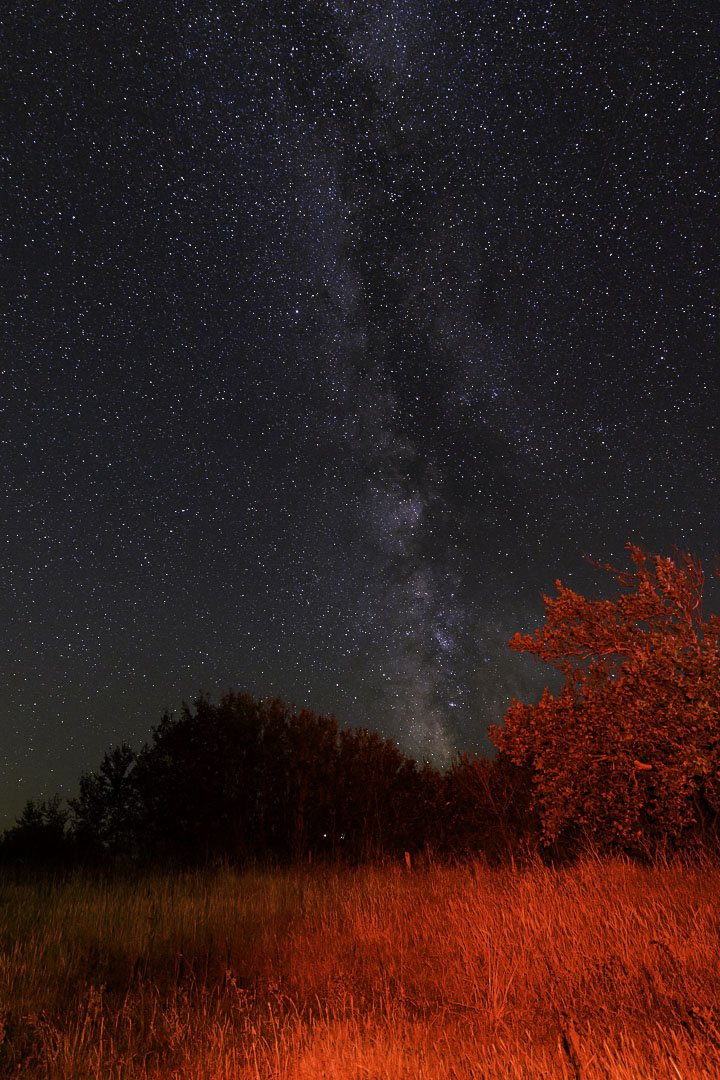
Astrophotography requires a different way of seeing. Focusing becomes deliberate. Exposures lengthen. Familiar silhouettes lose their details and become anchors beneath the sky. And the camera begins to reveal stars and colour that the eye perceives only partially.
Standing beneath the Milky Way after spending hours concentrating on salt crystals, snails and birds created an extraordinary change of scale. In the morning, a droplet of water can become the entire photograph. At night, the frame can contain light that has travelled across our galaxy.
After sunset, the island changes scale — from the smallest details to the Milky Way.
Wildlife, macro, landscape, long exposure and astrophotography may appear to be very different photographic disciplines. Increasingly, I see them simply as different ways of asking the same question:
What becomes visible when we give ourselves enough time to look?
That question became the thread connecting photographs that might otherwise seem unrelated. Salt crystals and stars belong to completely different scales, just as a bird in flight and a thirty-second exposure of the Atlantic require different techniques. But each asks for a form of attention. The camera becomes less a machine for collecting subjects than a reason to remain with them long enough for their less obvious qualities to emerge.
Letting go
Perhaps this is what photography has taught me most over the years. The more seriously I photograph, the less interested I become in controlling every outcome.
Nature rarely cooperates with the photograph imagined in advance. Birds turn away. Clouds cover the sun. Wind arrives at the wrong moment. The tide changes. A promising sky becomes empty. Sometimes nothing happens.
And sometimes, once I stop insisting on the photograph I thought I wanted, something else appears. Photography is becoming less about collecting images and more about experiencing places deeply enough for something unexpected to reveal itself.
This is not the same as photographing without intention. On the contrary, intention becomes clearer once it is separated from expectation. I can choose where to stand, what lens to use and what kind of visual language I am searching for, while still leaving room for the place to contradict me. Some of the images I value most from this journey came from exactly that space between preparation and surprise.
Thirty years later, what had really changed?
So, had Île de Ré changed? Inevitably. But that is not what stayed with me.
What I felt most strongly was continuity: the Atlantic, the wind, the salt marshes, the low horizons, the birds — and that remarkable light. The island I remembered was still there. My relationship with it had changed.
Thirty years ago, I saw a beautiful island. This time I saw systems, gestures and moments: seawater slowly becoming salt; a saunier reading wind and water; a lapwing flashing green; a cormorant becoming part of the geometry of a marsh; evening light travelling across water; tiny shells transformed into sculpture; the Atlantic becoming silent during a thirty-second exposure; the Milky Way emerging after the last colour had disappeared from the horizon.
Perhaps places do not always need to change for us to rediscover them. Sometimes we simply need to return with different eyes.
Returning after such a long absence also made me aware of how photography changes memory. I cannot reconstruct exactly what I saw on Île de Ré thirty years ago, but I can recognise what I failed to see. I remember the island as a whole; this time I came home remembering details. That, perhaps, is the most significant difference. The place remained expansive, but my experience of it became more precise.
And perhaps that is one of the greatest privileges photography gives us: a reason to stop, a reason to look — and occasionally, a reason to do absolutely nothing but watch the light change.
Explore the photographs
This journey through Île de Ré brought together landscapes, wildlife, macro photography and the Atlantic night sky — different ways of looking at the same place.
The complete series of 30 photographs is now available in a dedicated album, from the salt marshes and their wildlife to the Phare des Baleines beneath the stars.
Explore the Île de Ré Photo Album
Interested in a photograph?
Not every photograph featured in this album or story is part of my current Fine Art collection. If a particular image speaks to you, feel free to get in touch. I would be happy to discuss the possibility of creating a Fine Art print upon request.
Beyond the journey
Some of the photographs from Île de Ré also connect with my Fine Art practice, which explores the natural world through three complementary perspectives: the forms and textures of landscapes, the presence of wildlife, and the hidden structures of smaller lives.
Explore the Fine Art Collections
Explore the Albums by theme - Wildlife, macro photography, landscapes, astrophotography and other visual explorations.
Explore the Albums by place - Photographic journeys across Europe, Asia, Africa, the Americas and Oceania.