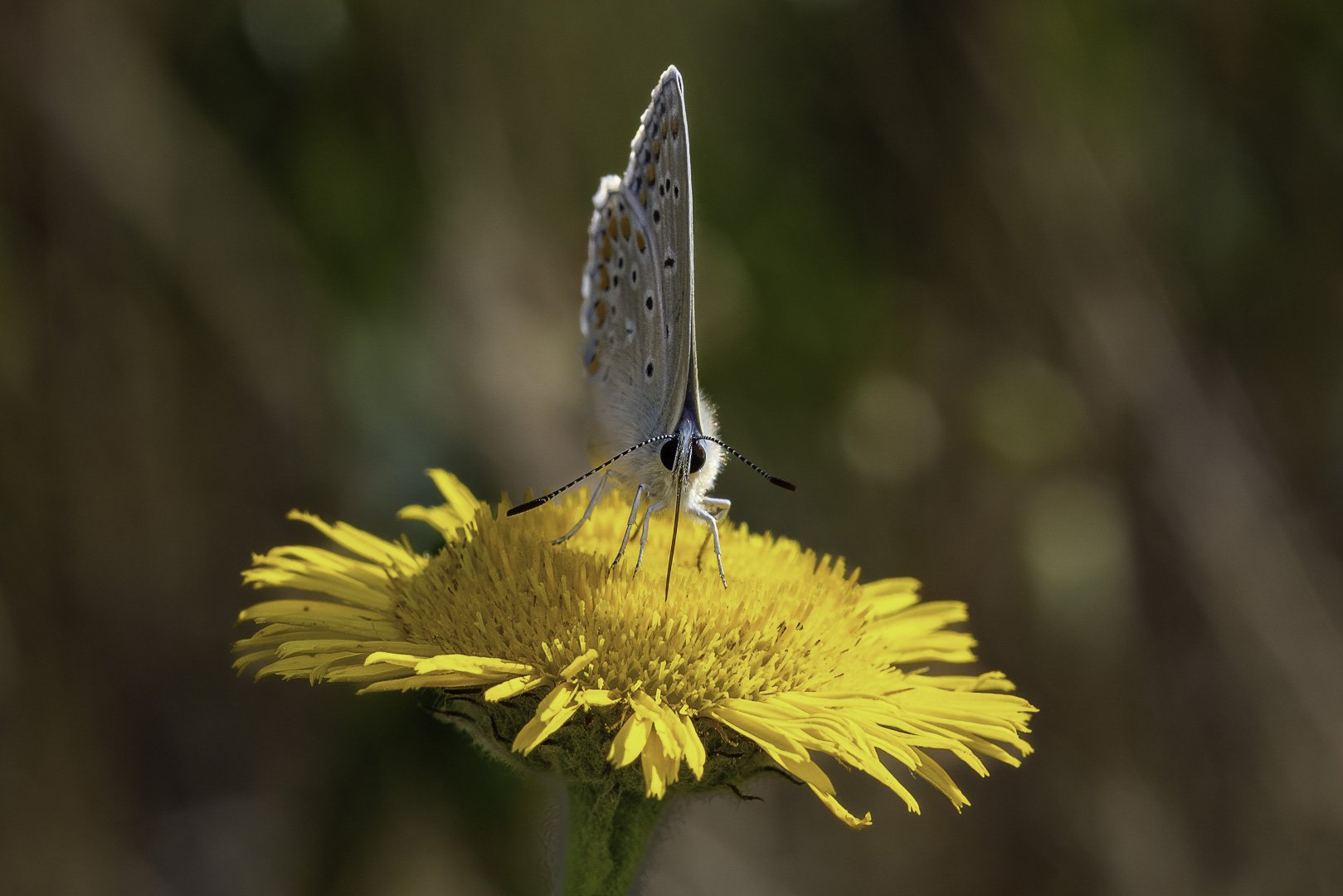
The Art of Macro Photography: Discovering the Invisible World
What photographing insects, flowers and the smallest details of nature has taught me about light, patience and the art of seeing.
A world at another scale
Macro photography did not simply give me new subjects. It changed the scale at which I pay attention. A flower stopped being only a flower; a wing became an intricate structure, a drop of water became a study of light, and a dry stem could become a complete composition.
At close range, familiar subjects begin to lose their familiar appearance. The delicate veins of an insect's wing, the repeated geometry of a seed head or the fine textures of a petal reveal a complexity that is easy to overlook with the naked eye. What appears simple from a distance can become remarkably intricate when examined more closely.
Strictly speaking, macro photography refers to photographing a subject at or near life-size magnification on the camera's sensor. But its appeal extends beyond magnification. It changes how we understand scale, allowing details measured in millimetres to occupy an entire image.
That change in perspective is what continues to fascinate me. A small subject does not need to be rare or spectacular to become visually compelling. Sometimes, the most interesting photograph begins with something I have passed many times without noticing.
The Art of Patience: Photographing Living Subjects
Macro photography rewards very little impatience. At high magnification, a movement of only a few millimetres can completely change the composition. A light breeze moves a flower out of focus. An insect turns away just as the light becomes interesting. A promising background changes when the subject shifts position.
Photographing insects adds another layer of unpredictability. Unlike a static object, a dragonfly, butterfly or praying mantis follows its own behaviour. Each has a different posture, way of moving and relationship with its surroundings. Understanding those differences matters as much as recognising an attractive composition.
Depth of field is another challenge. At close focusing distances, the area that appears sharp can become extremely narrow. The position of the camera therefore matters enormously: a slight change in angle can determine whether an insect's eyes, wings or body are rendered clearly. It can also change how the background relates to the subject.
I have learned that the answer is not always to take more photographs. Often, it is to observe longer. Watching how an insect settles, how a flower moves in the wind or how the light travels across a surface helps me recognise the moment when the elements begin to work together.
This patience is not simply a technical necessity. It is part of my approach to photographing living subjects. I prefer to work with their natural behaviour rather than interfere with it. The photograph should come from the encounter, not from forcing the subject into a predetermined image.
Contact:
contact@josephBphotography.com
When Light Reveals the Invisible
At close range, light becomes more than illumination. It reveals the physical character of a subject: the translucence of a petal, the fine hairs along an insect's body, the reflective surface of a beetle's wing covers or the almost weightless structure of a dandelion seed head.
The direction of light can completely transform these details. Side lighting emphasises texture by creating small shadows across a surface. Backlighting can reveal structures that remain almost invisible under frontal illumination. Soft, diffused light reduces harsh contrasts and allows subtle variations in colour and form to emerge.
Consider a dandelion seed head. From a distance, it appears as a pale sphere. In a macro photograph, its radiating filaments become a complex arrangement of lines, intersections and delicate spaces. When light catches those filaments from the side or behind, the subject can appear almost luminous.
Flowers offer a different experience. Their petals may transmit light rather than simply reflect it. Backlighting can reveal variations in thickness, fine veins and overlapping layers, giving a familiar flower an unexpected sense of depth.
Insects introduce still more possibilities. The hard, coloured wing covers of a beetle respond differently to light from the transparent wings of a dragonfly. One may reveal its shape through reflections and contrast; the other through an intricate network of veins and membranes.
These differences influence the way I compose a photograph. I am not always trying to show every detail with equal clarity. Sometimes, allowing part of a subject to disappear into shadow makes its structure more expressive. At other times, a simple background gives a delicate form the visual space it needs.
The most interesting light is not necessarily the brightest. It is the light that reveals something worth looking at.
Beyond Identification: The Fine Art of Macro Photography
A photograph of an insect can be valuable because it allows us to identify a species or examine its anatomy. Scientific and documentary photography have an important role in revealing the natural world. My Fine Art approach begins with the same curiosity, but asks a different question.
Rather than concentrating only on what a subject is, I am interested in how it can be seen.
A beetle resting among dried seed heads, for example, offers more than an opportunity to record its colours and markings. The curves of the stems, the contrast between the insect's body and the pale vegetation, and the space surrounding it all contribute to the image. The subject remains recognisable, but the photograph becomes a composition in its own right.
The same applies to flowers, fungi and natural textures. A petal can become an arrangement of translucent planes. The underside of a mushroom can reveal repeating lines and delicate transitions of light. A fragment of bark or a dried leaf can suggest a landscape when its original scale is no longer immediately apparent.
Composition is essential to that transformation. At close range, backgrounds can become surprisingly prominent, even when they are out of focus. Their colours, brightness and shapes influence the way the subject is perceived. I often find that simplifying the background is just as important as choosing the subject itself.
This is the territory explored in my Fine Art collection, The Invisible Life. It brings together photographs of small natural forms and living subjects, not as a catalogue of species, but as individual compositions shaped by light, colour, structure and space.
For me, a successful Fine Art macro photograph does not simply make a small subject appear larger. It allows the viewer to discover something in that subject that might otherwise have remained unnoticed.
What Macro Photography Changed in the Way I See
The influence of macro photography does not end when I put away the macro lens.
Working at such a small scale has changed how I approach landscapes. I pay greater attention to the texture of stone, the patterns left by water, the repetition of natural forms and the way light separates one surface from another. A vast landscape can be impressive, but a small fragment of it may contain an equally compelling composition.
It has also influenced my wildlife photography. Observing insects taught me to pay closer attention to behaviour and to the relationship between a subject and its environment. The same patience is useful when photographing birds or mammals. Sometimes, the gesture that makes a photograph meaningful is almost imperceptible.
Above all, macro photography has reinforced my interest in the relationship between observation and interpretation. The camera can describe a subject accurately, but it can also reveal visual qualities that are difficult to appreciate in everyday life.
That distinction runs through much of my Fine Art work. The Invisible Life explores the structures and delicate forms of the miniature world. Fragile Lives considers animals within their natural environments. Earth as Matter approaches landscapes through texture, colour and natural geometry.
Their subjects differ, but they share a common approach: looking beyond the immediately recognisable to discover what gives a photograph its lasting presence.
Macro photography taught me that visual richness is not a question of size. A few centimetres of nature can contain the complexity, balance and beauty of an entire landscape.
And sometimes, looking closer is enough to change the way we see everything else.
The smallest details leave a lasting impression.
Macro photography has taught me that a photograph does not need an extraordinary subject to become extraordinary. What matters is the relationship between the subject, the light and the attention we give it.
A delicate wing, a weathered petal or the intricate structure of a seed head can hold our gaze long after we have recognised what we are looking at. That is what I seek in my Fine Art work: photographs that invite us to discover more than we noticed at first.
Explore the Fine Art Collections
Explore the Albums by theme - Wildlife, macro photography, landscapes, astrophotography and other visual explorations.
Explore the Albums by place - Photographic journeys across Europe, Asia, Africa, the Americas and Oceania.
-
![Close-up of a red common poppy glowing against a deep black background, revealing its delicate petals and vivid contrast.]()
Genus Papaver - Common Poppy
-
![Stereum mushroom growing on a tree trunk, its layered form catching soft forest light.]()
Stereum
-
![Brown grasshopper captured in close-up on a fabric sofa, highlighting its detailed eyes and textured body.]()
Grasshopper
-
![Golden resin droplets on a tree trunk, shimmering like tears in warm sunlight.]()
Golden Tears
-
![Blue Butterfly resting on a yellow flower]()
Butterfly